PhotoPrism
- DevOps
- Infrastructure
- Self-Hosting
- Deployment
Overview
Overview
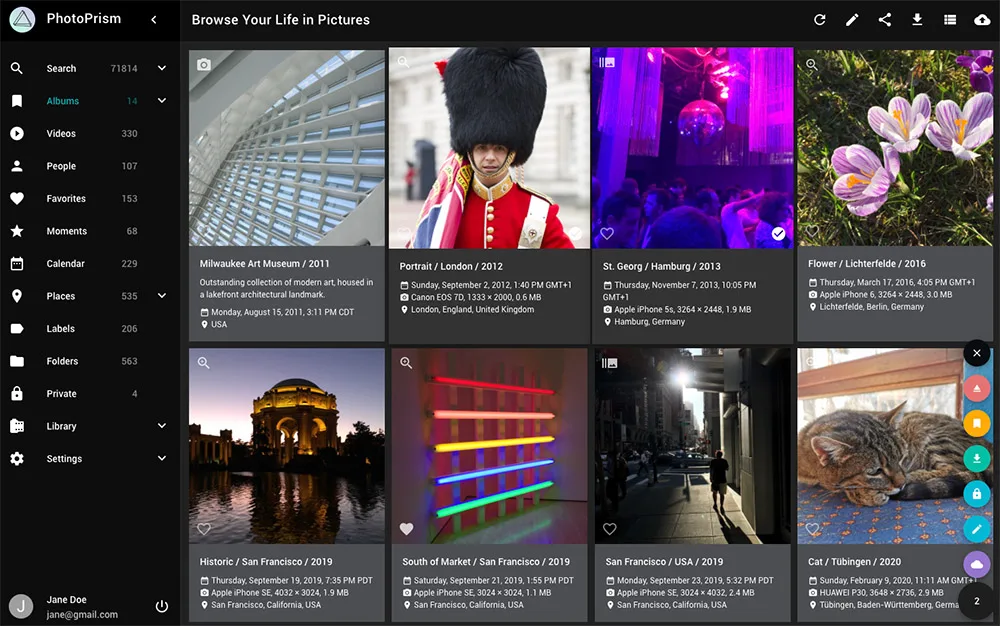
Photos and media pile up across the company — for documentation, project reports, marketing and technical work. To manage, search and organise them efficiently, I introduced PhotoPrism, an open-source media library. The goal: a privacy-friendly, self-hosted system for central image management with modern features like AI-powered image recognition, face detection and automatic categorisation.
Tasks & implementation
Requirements & solution choice
- Defined the requirements for an internal image database
- Chose PhotoPrism for its feature set, privacy-friendliness and Docker compatibility
System preparation
- Provisioned a new VM
- Created a dedicated media storage path via an SMB share
Installation & configuration
- Deployed PhotoPrism with Docker Compose
- Configured user accounts, storage paths and metadata options
- Added automated backups of the media directory
Import & structuring
- Migrated existing image archives (e.g. from Nextcloud and local directories)
- Combined manual tagging with PhotoPrism's automatic tag detection
- Set up albums by department, project and use case
Integration & access
- Integrated it into the existing intranet dashboard (tool overview)
- Defined user groups, roles and permissions
- Trained the departments on usage and upkeep
Result
A modern, intelligent media-management system for the entire company: better access to project image documentation, automatic recognition and sorting by content, place and time, and a single, audit-proof and searchable archive for all photos — privacy-compliant and internal, with no external cloud.
Platforms & tools
- PhotoPrism — open-source photo management
- Docker & Docker Compose — simple, scalable deployment
- SMB share — central media directory
- Nginx / Caddy — reverse proxy with HTTPS
Highlights
- AI-powered image recognition & automatic categorisation
- Face detection and content/place/time-based sorting
- Self-hosted on Docker — full data control, no external cloud
- Central, audit-proof and searchable archive for all departments